Lifecycle
weftkit owns your plugin from onEnable to onDisable. Extend WeftPlugin and the whole
cycle runs itself, with BukkitWeft.enable and BukkitWeft.disable as the underlying calls for
plugins that want manual control.
Startup
BukkitWeft.enable builds the loader and brings up every @Singleton in
dependency order. As each singleton is created, if it implements Loader its load method
runs. Returning false
from load aborts startup: weftkit tears down everything it has already loaded, in reverse
order, and disables the plugin, so you never run in a half initialized state. Once every
singleton has loaded, the modules activate in load order; the bundled listener
module registers each @Wired listener with the server. A module
that aborts activation triggers the same full teardown as a failed load.
@Override
protected void onWeftEnable(WeftLoader loader) {
    // Runs once every singleton is up and the listeners are registered. When a component
    // aborts startup, weftkit disables the plugin and this hook never runs.
}
Threading
The loader is confined to the thread that created it, on Bukkit the server main thread. Any
call touching mutable loader state fails immediately from another thread with a clear exception
instead of silently racing the graph. That covers creating components inside an async task as
well as reads like get and the load timings; only views of the immutable registry, such as
loadOrder or contains, work from anywhere. Async work should gather its inputs up front or
hop back to the main thread before touching components.
Load order
Load order follows the dependency graph. A component loads after every component it depends on,
so a singleton can rely on its dependencies being fully loaded inside its own load. A value
exposed with @Provides is captured right after its owner loads and is injectable from then on.
A getter that still returns null at that point fails startup, so a forgotten field surfaces
during load instead of at the first injection. For ordering that is not expressed through
constructor dependencies, @Initializes and @Requires place a component after the singleton
that sets up the static holders it reads. Holders are classes marked @StaticHolder, and reading
one during construction or load without declaring @Requires fails the build.
Shutdown
On disable, the modules deactivate in reverse activation order, the listener module
unregistering exactly the listeners it registered. weftkit then runs unload on every loaded
singleton in reverse creation order, lazy singletons interleaved where they materialized, so a
component is torn down before the ones it depended on, and every captured @Provides value is
dropped. Teardown keeps going even if one
component's unload throws, and the failures are reported together at the end. Teardown is safe
when startup aborted or never ran.
@Override
protected void onWeftDisable(WeftLoader loader) {
    // Runs before teardown, with every component still resolvable
}
Reloading
weftkit deliberately has no framework level reload. Recreating components at runtime cannot fix
references captured outside the graph, like scheduled tasks, command executors, or other plugins
holding your API service, and those stale references are exactly the bugs that made /reload
infamous. Reload in place instead: give the singleton that owns the state a reload method and
let dependents read through it, so nothing ever goes stale.
@Wired
@Singleton
public final class Config implements Loader {

    private volatile Settings settings;

    @Override
    public boolean load() {
        return reload();
    }

    public boolean reload() {
        Settings parsed = parse();
        if (parsed == null) return false;
        settings = parsed;
        return true;
    }

    public Settings settings() {
        return settings;
    }
}
A reload command is then one line: loader.get(Config.class).reload(). Components that injected
Config call settings() when they need values and always see the current state.
Diagnostics
The loader exposes what happened during startup. loadOrder returns the singleton load
sequence, totalLoadTime returns the combined startup cost for a one-line enable log, and
loadTimings returns how long each singleton took to construct and load, in load
order, as a snapshot that is safe to hand to another thread.
loader.loadTimings().forEach((type, duration) ->
        getLogger().info(type.getSimpleName() + " loaded in " + duration.toMillis() + "ms"));
The processor also writes the full dependency graph as weftkit-graph.dot next to the generated
registry sources (under build/generated/sources/annotationProcessor). Render it with
Graphviz to see your plugin's wiring, where every edge points at a
dependency:
The player-homes example renders to this, its two commands sharing
the HomeStore singleton, which loads homes through the package-private HomesFile, alongside
the bundled listener, command, and metrics modules:
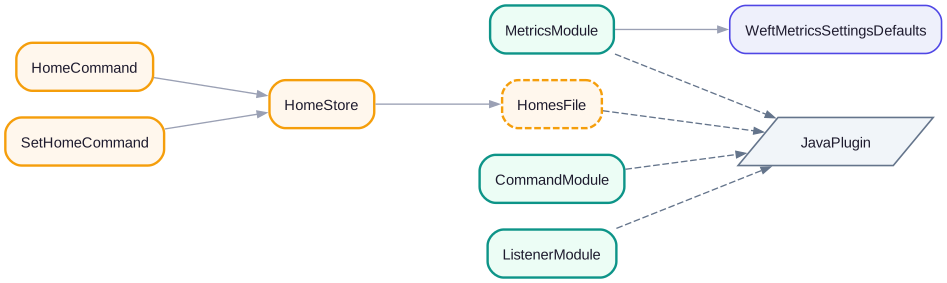
weftkit-graph.dot for the player-homes example, rendered with Graphviz.The nodes and edges carry a small visual vocabulary:
| Element | Meaning |
|---|---|
| Indigo box | A plain @Wired component, created fresh for every injection. |
| Amber box, thicker border | A @Singleton, created once. |
| Teal box, thicker border | A module, an eager singleton with activation hooks. |
| Grey dashed box | A static holder ordered through @Requires / @Initializes. |
| Dashed border | A package-private component, kept off your public surface. |
feature: name badge |
The component is gated by a @FeatureFlag; the badge names the flag. |
| Solid edge | A constructor dependency. |
| Dashed edge | A @Requires ordering edge, amber when it points at the holder's initializer. |
The Loader hook
Implement Loader on any singleton that needs to do work at startup or shutdown. load runs as
the singleton is created and unload runs on shutdown. Only singletons may implement Loader,
since a per-injection component would never have its load called.
@Wired
@Singleton
public final class Metrics implements Loader {

    @Override
    public boolean load() {
        // start up here, return false to abort the plugin
        return true;
    }

    @Override
    public void unload() {
        // release resources here, runs in reverse creation order
    }
}
The player-homes example runs this cycle end to end: it loads
homes from disk in load, aborts startup on a corrupt file, and saves in unload.
Related
- Components: what gets loaded, and how the order is decided
- Modules and feature flags: module activation inside the lifecycle
- Troubleshooting: the errors the processor raises for broken graphs
- player-homes: the lifecycle end to end in a runnable plugin